

Author Archive
The growing demand for outsourced image-to-text & handwritten data transcription
Scanned documents, legacy records, legal files, and medical entries continue to hold untapped data in massive volumes. Yet, for most organizations across industries, extracting the data internally has proven to be impractical and inefficient. This sheer gap paved the road for demand for scanned document transcription BPO services to surge immensely. It no longer holds the place of a cost-effective move; rather, it has become a strategic necessity in asset building and operational continuity. That being said, let’s explore the situations fuelling this demand spike for service outsourcing.
Data holds no value if it’s not searchable, auditable, and structured
In today’s technology-driven world, digitization alone can never help organizations outsmart competitors and emerge as key market players. Businesses have learned the hard way that storing images and scanned PDFs can never make data truly usable. That’s why the demand for image to text transcription outsourcing India has skyrocketed in recent years. To help you understand the scenario better, we have specified the key influencers below.
- Only structured outputs are compatible with ERP, CRM, and analytical tools.
- Searchable text layers have become imperative for instant data retrieval.
- Audit-ready accuracy facilitates compliance adherence and caters to government regulations.
Outsourced transcription providers won’t just convert the images to text— they will normalize, tag, validate, and structure data in ways your in-house teams seldom have the bandwidth or capability to perform.
Handwritten data is the last “dark data” that enterprises can’t ignore
Information written in the traditional, handwritten method continues to be one of the largest unstructured dataset across multifarious industries. These include:
- Doctors’ notes and prescriptions
- Historical archives and research logs
- Insurance claim forms
- Field inspection reports
Even the advanced OCR struggles in data interpretation due to handwriting variability, abbreviations, context, and multilingual scripts. With handwritten data transcription outsourcing, this gap can be effortlessly filled, thanks to seamless access to AI-assisted recognition with human validation. As a result, accuracy levels will be amplified to an extent that purely automated systems can’t match.
Internal teams are structurally inefficient for high-volume transactions
Most organizations underestimate the hidden expenses and last-minute cost surprises of managing in-house transcription teams. Here what’s included in the list.
- Handling rework due to accuracy failures
- Hiring and training specialists for short-term spikes
- Managing quality assurance workflows
- Diverting skilled staff from revenue-generating workflows
It is with transcription outsourcing that businesses can convert these tedious but necessary tasks into a scalable, on-demand function with predictable turnaround times and defined accuracy SLAs.
Compliance pressure is pushing transcription accuracy to new levels
From legal to healthcare, finance, and government, organizations encounter stringent data integrity regulations. Even a minor transcription error can trigger:
- Audit failures
- Regulatory penalties
- Claim rejections
- Legal exposure
However, with professional image to text conversion and handwritten transcription services, businesses can minimize these risks significantly. That’s because these vendors leverage:
- Version-controlled data handling
- Multi-layer quality checks
- Secure access protocols
- Traceable correction logs
Given how accuracy is now a risk management function and not a clerical task, investing in this compliance-first approach has become necessary for businesses in today’s time.
Data migration and system modernization are creating sudden transcription surges
When organizations modernize legacy systems, they uncover massive volumes of scanned documents, image-based files, and handwritten records never designed to operate with modern systems. These migration projects are time-bound, unforgiving, and high-risk. Here’s why.
- Legacy records need to be converted into structured, system-readable formats
- Internal teams often get stretched in managing core transformation
- Manual cleanup increases error probability and project overruns
This is where document digitization and transcription outsourcing come into play, absorbing these sudden data spikes without hindering internal workflows. To top it off, these align transcription outputs directly with the target system’s data schema, thereby reducing post-migration reconciliation.
Analytics, AI, and automation depend on clean transcribed data
AI initiatives and automation routines often fail due to unusable input data. Handwritten documents and image files may contain valuable information, but they need accurate transcription and proper structuring. Here’s why.
- Poor transcription quality can introduce bias and noise into analytics.
- AI systems require labelled, normalized text— not raw images.
- Automation workflows break when data lacks structural integrity.
With data entry services now available at ease, businesses can bring more clarity in massive volumes of versatile datasets for technology adoption.
Conclusion
Outsourcing image-to-text and handwritten data transcription is no longer a tactical decision— it’s a scalability and governance strategy. By turning fragmented visual records into structured digital assets, businesses can unlock automation, analytics, and decision-making capabilities that internal teams cannot sustain.
Data Entry For HR Departments: Managing Employee Records, Payroll Inputs & Recruitment Data
Every HR department relies on good data handling. HR teams rely on smooth data processes for many things, from dealing with private information about employees to making sure the payment entries are correct. In order to maintain accuracy, safety, and efficiency as HR operations become more complicated, many organizations now prefer specialized support, such as HR data entry support outsourcing. This blog talks about how reliable data entry helps HR teams keep track of payroll, employee records, and recruiting information in a timely manner.
Importance of Accurate HR Data Management
Keeping HR data organized and free of mistakes ensures that daily operations run smoothly. Human Resources has to deal with a lot of information about employees, like their personal details, how often they show up to work, how well they do their jobs, and paperwork about their pay. When this data is treated correctly, it helps businesses make smart choices, stay compliant, and better control their staff.
Why Organizations Need Strong Data Processes
Human Resources teams handle regulatory needs, inter-departmental teamwork, and jobs that need to be done right away. A system that is well-managed speeds up information access, lowers the chance of differences, and helps with strategic planning. Also, businesses often use HR outsourcing partners to do jobs that need to be done perfectly the same way every time.
Employee Records Management Through Structured Data Entry
Employee records are very important to the work that HR does. It is essential for safety and checks that these records are always kept up to date and checked.
Key Components of Employee Records
Identification information, addresses, emergency contacts, joining papers, attendance logs, and performance assessments are all things that are usually considered data. Keeping these records using standardized methods helps prevent mistakes and having the same information recorded more than once.
Role of HR Data Entry in Record Accuracy
AccurateHR data entry makes sure that all of the information is entered in the proper manner and saved in a way that the system can use it. When records are kept in an organized way, HR can quickly handle requests, answer questions from management, and help with making important decisions. To keep these records without making their own teams too busy, a lot of businesses depend on HR data entry support outsourcing.
Payroll Inputs and Data Accuracy
One of the most essential HR tasks is payroll. Mistakes of any size can have an impact on how happy employees are, how well rules are followed, and how companies report their finances.
Components of Payroll Data
Attendance, overtime, deductions, tax details, bonuses, reimbursements, and perks are all usually part of payroll. Putting this information together and checking it over correctly makes sure that employees are paid on time and correctly.
Importance of Payroll Data Entry
Professional payroll data entry makes sure that payroll records are up to date and in line with the actions of current employees. Businesses rely on payroll data update back-office teams to handle large amounts of data and keep a transparent, audit-ready system, as outsourcing has become more popular. This kind of help makes payments more accurate and lowers the risk of making mistakes in calculations.
Why Many Companies Outsource Payroll Data Processes
Specialized teams not only make sure that everything is done correctly, but they also keep your information private by following strict rules. When businesses use HR BPO services, they can simplify payment tasks while still making sure they follow the rules and protect their data.
Recruitment Data Entry for Faster Hiring Cycles
Managing employment data can get to be a lot, especially when there are a lot of applications. Screening notes, interview scores, resumes, hiring paperwork, and information about candidates need to be updated right away.
How Recruitment Data Entry Helps HR Teams
Accurate recruitment data entry makes sure that all candidate information is digitally organized, which makes it easier for recruiters to track, evaluate, and select candidates. A well-structured database speeds up interviews and the final choice, and it also makes sure that potential records aren’t lost.
Outsourcing for Faster Hiring
To handle administrative jobs related to hiring, many HR teams rely on HR data entry support outsourcing services. This speeds up hiring and gives HR workers more time to focus on strategic reviews instead of updating data all the time.
Conclusion
Data entry is a very important part of all areas of HR, from employee records to salary inputs and hiring processes. As workloads and legal demands grow, companies get help keeping HR data organized and correct. HR offices can stay productive, legal, and future-proof by working with teams that are proficient in payroll data update back-office.
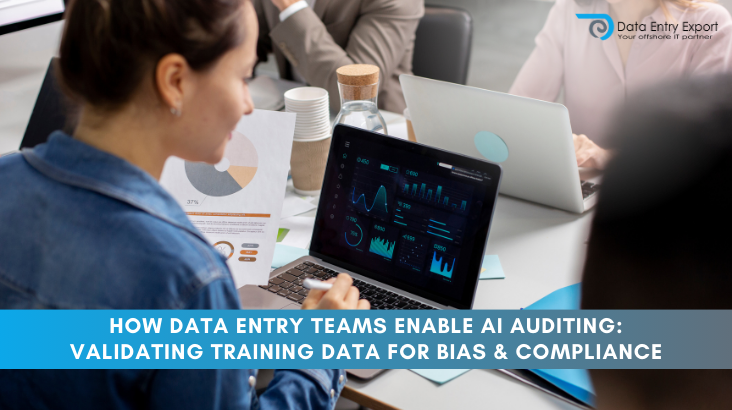
How data entry teams enable AI auditing: Validating training data for bias And compliance
There’s no doubt that AI systems have been embedded in day-to-day business operations lately. Owing to this, the fairness, quality, and regulatory compliance of training data have become inviolable. Looking at the broader perspective, most of the limelight falls upon data scientists, machine learning engineers, and analysts. However, in the midst of this, we often end up overlooking the critical role played by data entry and preparation teams.
These professionals have taken up the role of frontline auditors, ensuring every dataset being fed to the AI system is accurate, complete, unbiased, and compliant. That being said, we have further explored how modern data entry teams contribute to AI auditing unequivocally.
Structuring raw data for audit-ready AI pipelines
If you see a raw enterprise-level dataset, it will be nothing less than a scattered mess— spread across invoices, emails, PDFs, CRMs, chats, IoT logs, and many more. Before it’s fed to the AI training model, organization and normalization should be performed meticulously. This is where data entry teams come to play, enabling:
- Standardization: Converting unstructured formats into machine-processable, consistent structures so that auditors can trace data flow mechanisms into the AI models.
- Versioning and traceability: Documenting origin, transformation history, and ownership details for algorithmic audits and proofs of provenance.
- Dataset completeness checks: Detecting hidden biases, anomalies, and mismatched units faster than automated tools.
The result of such structuring is a clean, standardized dataset necessary for ethical AI training.
Identifying and rectifying biases before reaching the models
One of the many reasons why training data validation has become paramount is to eliminate biases. These are often introduced in subtle manners— through over-representation, cultural skews, incomplete attributes, and historical inequalities in the source materials. Now, automated scanners are capable of detecting numerical mismatches only. They are not designed to understand sociolinguistic, contextual, and domain-specific biases.
So, to maintain AI compliance across the processes, data entry professionals are responsible for:
1. Flagging sensitive attributes: Identifying fields that might cause discrimination in the outcomes, like geolocation, age, gender, and socioeconomic indicators, followed by further marking for restricted usage or anonymization.
2. Balancing representations: Ensuring training datasets can reflect real population diversity with zero inclusions of minority categories artificially, once skewed sampling patterns are detected during categorization tasks.
3. Human-in-loop contextual fairness checks: Guaranteeing zero biases via thorough input verifications based on human perceptions, like:
- Loan notes with subjective adjectives
- Customer sentiment transcripts implying biases
- Product review datasets containing hate speech
- Job applications with gender-coded language
4. Ensuring annotation consistency: Refining annotation guidelines, running multi-scorer consensus checks, and cross-reviewing one another’s work to eliminate the risks of potential subjective drifts in the narrative or context.
Enforcing data privacy & regulatory compliance during preparation
Apart from bias detection and correction, data entry teams are also concerned with end-to-end compliance adherence without fail. Governments have imposed multifarious regulations, dictating what data can be used, how it should be stored, for what purpose, and who can utilize it. Violations originating from the data pipeline can put organizations at high risk. That’s why professionals enforce compliance via:
- Data minimization: Instantly flagging unnecessary datasets being pushed into the AI pipelines.
- PII and PHI redaction: Validating automated redaction tool outputs through manual checks for sensitive or customer-related information.
- Consent verification checks: Cross-validating if the records fed for training have been collected with appropriate consent models, depending on specific jurisdictions.
- Maintaining audit logs: Logging every correction, change, or decision for regulatory AI auditing.
- Regulatory buckets classification: Categorizing datasets into the correct compliance bucket before AI usage clearance.
Validating data quality for algorithmic accuracy
Outdated entries, incorrect labels, and duplicate records can introduce discrepancies into the AI model outcomes. As a result, they will fail to simulate real-world conditions, forcing the entire team to restart the pipelines. That’s why data entry teams perform thorough Quality Assurance checks via:
- Ground-truth verification: Ensuring the training datasets can mirror real-world scenarios without any gap.
- Deduplication and normalization: Guaranteeing uniqueness by removing duplicate records before dataset consolidation.
- Outlier and edge-case checks: Identifying misclassifications, unusual behavior patterns, and extreme values.
- Continuous re-verification: Performing periodic checks to ensure shifts or drifts in inputs cannot introduce new biases or errors.
Conclusion
AI auditing isn’t just a mere technical exercise— it’s an ethical, operational, and regulatory process that requires human perception and judgment across the pipeline. That’s data entry teams strive hard to clean datasets, detect contextual biases, enforce privacy, document metadata, and verify quality before they are fed to the AI training models.
How Blockchain Technology is Influencing Data Entry & Document Verification Workflows
Blockchain is transforming how organizations process information and verify documents. Typical data entry systems encounter problems such as duplicated information, forgery, and loss of authenticity. However, blockchain offers contemporaneous benefits in terms of information transparency, traceability, and the secure verification of each record.
Through the employment of decentralized technology, firms can now have error-free and immutable workflows. All this implicit shift has created demand for blockchain-based data entry services outsourcing India, giving rise to safe and better ecosystems of information around the globe.
Understanding Blockchain in Simple Words
Blockchain is a digital ledger that stores information across other systems instead of a single, central database. Each transaction that happens is called a “block,” and they are, in turn, securely tied to the next block, forming a chain. Therefore, a given block is unalterably linked to the next through encryption and timestamping with network verification.
This decentralized business model allows information exchanges to be transparent and creates trust among everyone involved in the transactions. Every change or addition to a transaction will be visible, thus establishing total accountability. At first seen as crypto conducting, blockchain today has become trendy and supports secure data management in almost every industry: health, finance, logistics, and government.
Current Challenges in Traditional Data Entry & Verification
Traditional methods of data entry and verification are challenged by a host of issues that impact their accuracy and reliability. They include;
- Manual entry introduces typographical errors and inconsistencies into records.
- Stand-alone databases increase risk exposure for hacking and modifications.
- Difficulty in tracing document changes confuses and jeopardizes compliance.
- Verification of documents is done through third parties, which slows approvals and adds costs.
- Without digital document security, you have no safety against tampered or fraudulently signed data submitted.
- Without an audit trail, it would be nearly impossible to establish accountability.
It’s these challenges that position blockchain BPO solutions as a much-needed option for efficient and trusted document verification processes.
How Blockchain Transforms Data Entry Workflows
Blockchain brings automation, decentralization, and permanency to typical data entry processes. Thereby, it is giving greater certainty and verifiability to information in real time through offering.
- Permanency: Once the information you put, it stays permanently. This provides a permanent record for that information and creates verifiable data integrity.
- Smart Contracts: Automation rules of verification to approve or disapprove entries in real time before storing them.
- Decentralized Data Sharing: Multiple users can access a single verified record of the data. They will not have to duplicate entries or experience time lags.
- Audit Trail: All activity on the data lines in chronological order with date & time. This will provide assurances of transparency and compliance.
- Controlled Access: Only individuals with a license can access the data in the blockchain through their particular access keys.
Through blockchain data entry, companies are able to lessen operational errors, heighten compliance while creating secure and tamperproof databases. Overall, this means organizations can have accurate data workflow around the world in finance, healthcare, and supply chain management.
The Role of Blockchain in Document Verification
When implementing a blockchain-based document management system, it provides authenticity and validation of ownership. This will help you establish an immutable digital history of a document.
- Instant Validation: The digital signature associated with each document will exist on the blockchain and, in a matter of seconds, will be verified.
- Fraud Prevention: Users may alter or create another document that utilizes a hash algorithm, making it impossible to amend or duplicate on the blockchain.
- Identity verification: Blockchain will link record-keeping with true user credentials to verify information.
- Cross-industry Applications: Providing authenticity and traceability with a historic property title or medical report, blockchain can broadly apply across multiple industries.
- Fewer Layers of Intermediaries: Inherently, validation of documents leveraged by blockchain will eliminate delays incurred via a third-party verification process.
- Permanent Integrity: Users will always know that documents created will be accessible and unalterable for future auditing or verification.
Pulling together the data entry for blockchain verification outsourcing businesses will remove all hesitation and doubt about the authenticity and trustworthiness of a record. In doing this, the increased transparency factor will add to workflow efficiencies, whilst removing fraud and providing credible information in an industry based on certification.
Conclusion
Blockchain is changing the way data and documents are managed and validated. Organizations are ensuring accuracy, transparency, and trust in every record through a blockchain-based data entry service outsourcing India. Blockchain is an essential building block as an automation enabler, anywhere organizations exist and access data globally.Connect with us at [email protected] to know more.
The ROI Of Outsourcing Real Estate Data Management To India
In today’s competitive real estate market, it’s essential to be able to handle your info well. A business keeps many records, from control and listing information to transaction and safety data. Companies can significantly cut costs and improve operating efficiency by using real estate data entry services India. Let’s look at how sending real estate data jobs to India can help your business focus, get a better return on your investment, and do better in the long run.
Why Real Estate Data Needs Professional Handling
Clean, well-organized, and up-to-date info is essential for real estate businesses. It takes more than just storage space to keep track of listings, lease agreements, legal papers, ownership information, upkeep logs, and transaction records. It needs careful supervision.
When data entry goes wrong or takes too long, it can lead to misunderstandings, unhappy customers, legal issues, or even lost sales. A reliable method for handling data is essential for long-term growth and compliance, whether you’re a broker, investment company, or property manager.
Major Cost Savings
Cost savings are the most direct ROI benefit of hiring. It costs a lot to hire local teams and pay them well. You also have to pay for office space, tools, and training. Outsourcing to India, on the other hand, gives you access to skilled labor at much lower costs. For example, it can cut costs by up to 60% without lowering quality.
This lets real estate companies move their budgets to activities that bring in money, like marketing, sales, or adding new clients.
Access to Skilled Talent and Technology
Many people in India’s outsourcing industry know how to use real estate tools like Yardi, Buildium, AppFolio, and CRMs. Additionally, providers use technologies such as OCR and AI tools to help keep property data entry errors to a minimum. This speeds up processes while keeping quality.
Adopting new technologies in this way boosts output, which leads to a measured ROI over time.
Ability to Adapt and Grow
Businesses can change the size of their services as needed by outsourcing them. Peak seasons often need more resources, and Indian sellers can quickly adjust by hiring more people. It’s possible to lower costs when times are slow.
This adaptability helps businesses quickly change and grow without hiring too many full-time workers or building too much equipment.
Enhanced Focus on Core Operations
Real estate data entry and other administrative chores are necessary but not critical. By outsourcing, internal teams are free to focus on work that has a high value, like selling properties, managing clients, and planning for long-term growth.
57% of companies outsource so they can focus on their core business, according to Deloitte. Better customer ties, faster decisions, and faster bottom-line growth are what this means for real estate companies.
Better Accuracy and Compliance
Reliable outsourcing partners in India use multiple levels of quality checks to make sure the data they collect is correct. Many of them are ISO-certified and follow international standards for compliance, which keeps client information and privacy safe.
Listings, lease information, and tax calculations are less likely to be wrong when data is correct and well-organized. This protects business processes and customer trust.
Long-Term Strategic Advantages
Real estate outsourcing guarantees better organizational consistency in addition to cost savings. India’s 24/7 help approach works for clients all over the world and all of their time zones. SLA-driven contracts back up services, ensuring consistency, clarity, and reliability.
Outsourcing is an investment in the long run that helps growing businesses be more productive and last longer.
Business Insight and Analytics
Better research and reporting are possible with structured data from professional providers. This helps with making better business choices, predicting tenants, and keeping track of regulatory compliance, all of which are important for portfolio growth.
Real estate companies can turn raw data into strategic insights with the help of skilled services for data management India. This increases their ROI and gives them a competitive edge.
Conclusion
Outsourcing real estate data management to India has a clear ROI in the form of lower costs, better quality, and more flexible business operations. Using real estate BPO helps improve performance without putting too much pressure on internal teams. This is true for daily updates, legal paperwork, and CRM upkeep. India is still essential to the global real estate market because it has a skilled staff, high-tech tools, and flexible service options.
These are the clear benefits of outsourcing real estate data management: lower costs, better focus, scalable growth, and higher profits. Connect with us at [email protected] to know more.
Secure Data Handling Practices: Encryption & Confidentiality in BPO
What if your customer’s personal or financial data slipped into the wrong hands? Could your business handle the damage to trust, reputation, and revenue? For companies that rely on Business Process Outsourcing (BPO), this is not just a ‘what if’; it’s a real risk.
BPO firms manage sensitive information every single day, such as bank details, medical records, legal contracts, and client files. Without secure data handling, the consequences can be devastating. That is why encryption in BPO and strong data confidentiality practices are now essential.
This blog explores how BPO providers safeguard information using encryption, confidentiality agreements, global compliance, advanced tools, and transparency. It will also give you practical insights into why secure data entry outsourcing in India and encrypted BPO data processing services are trusted worldwide. By the end, you’ll see how outsourcing can remain secure, trustworthy, and future-ready.
Significance of BPO Data Security
BPO companies deal with huge amounts of confidential information on behalf of clients. Think of medical history in healthcare, payroll in HR outsourcing, or legal contracts in legal processes. If such information is mishandled, the result is not just financial loss, but also permanent damage to client trust. A single breach can trigger lawsuits, penalties, or even the loss of long-standing clients. So, would you hand over your critical data to a partner who cannot guarantee its safety?
BPO data security is the lifeline that keeps outsourcing services reliable and trustworthy. Without it, the cost savings and efficiency of outsourcing mean nothing.
Data Encryption in BPO Data Security
Let’s simplify encryption. It is like locking your information in a coded safe that only the right key can open. Even if hackers get access to it, they will see nothing but scrambled data. BPOs use different methods such as AES, RSA, and end-to-end encryption. These ensure protection whether data is traveling through emails and file transfers or sitting inside a database. For example, payroll files sent across borders become unreadable without the proper decryption key.
Imagine mailing cash in an open envelope; it is risky. Now imagine mailing it inside a tamper-proof vault, that is what encrypted BPO data processing services deliver. Encryption builds the foundation of secure outsourcing that clients can trust.
Confidentiality is Key in BPO Data Security
While encryption safeguards data, confidentiality ensures restricted access. This means stringent Non-Disclosure Agreements (NDAs), layered permissions, and limited access controls in the BPO sector. The healthcare providers must comply with the HIPAA regulations. This signifies that everyone who deals with patient records should sign confidentiality agreements, use secure systems, and undergo background checks. Having confidentiality ensures the clients that the outsourcing partner prioritizes their data as much as they do. This converts into long-term trust and repeat business partnerships.
Global Compliance Standards That Drive Security
Global compliance standards set the rules for secure data handling. They prove that BPO companies follow the best practices for protecting sensitive information. Some of the most recognized ones include:
- GDPR in Europe for personal data protection.
- HIPAA in the USA for healthcare data security.
- ISO 27001 for global information security management.
Why does this matter? Because a BPO provider handling your data in India, the Philippines, or anywhere else must meet the same security expectations as one in your own country. Following compliance doesn’t just keep them legally safe; it strengthens their brand reputation and positions them as a reliable partner.
Technology Tools for Secure Data Handling
Behind every secure BPO operation lies a stack of smart tools. These include:
- Firewalls and intrusion detection systems to block unauthorized access.
- Multi-factor authentication to verify user identities.
- Cloud security frameworks for safe data storage.
- AI-driven monitoring tools that detect unusual activity before it turns into a breach.
These tools work alongside encryption and confidentiality policies to build a strong defense. With secure data entry outsourcing in India, firms are adopting AI and cloud-based platforms to handle data with maximum safety and efficiency. This makes secure outsourcing safer, smarter, and more reliable.
Conclusion
Security is a vital factor in outsourcing. Selecting outsourcing partners with encrypted BPO data processing services or secure outsourcing helps businesses with cost savings. With secure data entry outsourcing in India, you can ensure your clients that their data is safe with you.
Are you looking for a secure data entry outsourcing in India? Data Entry Export is your ideal choice. We can help you with encrypted BPO data processing services. Connect with us at [email protected] to know more.

Scaling Data Entry Operations for E-Commerce & Catalog Management
Imagine you open a digital store site to buy shoes. The images seem captivating; however, the sizes are confusing, descriptions are incomplete, and the specifications do not align with the photos. Within seconds, you lose trust and click away. This does not happen rarely, but it is a daily loss for many online retailers. This is because of the weak catalog management and unscalable product data entry processes.
Ecommerce businesses thrive or decline based on how accurate, consistent, and comprehensive their product catalogs are. When catalog data is sloppy, customers hesitate. When catalog data is clean and reliable, sales grow naturally. Scaling ecommerce data entry and catalog management is a growing priority. In this blog, let’s analyze the way businesses can scale their operations, why it matters, and how data entry services for product catalog management can turn catalogs into a competitive advantage.
Why Scaling Data Entry Matters in E-Commerce
As ecommerce businesses expand, they face an avalanche of product data. New SKUs, diverse suppliers, seasonal promotions, and global marketplaces all contribute to this complexity. For customers, product information is not just data; it is the buying experience. A clear, well-structured catalog builds confidence, while errors drive abandonment.
Scaling data entry services for product catalog management means more than uploading items faster. It means building consistency across thousands of product descriptions, pricing details, images, and specifications. Poor catalog management directly leads to negative reviews, higher return rates, and lost customer loyalty. In contrast, structured e-commerce catalog data entry outsourcing solutions ensure that every detail supports the customer journey, making it easier for shoppers to find what they need and complete a purchase.
The Hidden Challenges of Catalog Data Entry
On the surface, product data entry seems simple: enter product names, descriptions, and prices. In reality, scaling these tasks introduces serious challenges, such as the retailers having to manage large amounts of SKUs over different categories. There will be constant updates such as stock levels, promotions and prices change daily, sometimes even hourly. Also, data is gathered from multiple sources such as suppliers, third-party marketplaces and in-house teams. When e-commerce businesses try to scale without proper systems, mistakes multiply. Customers see incomplete details, wrong images, or outdated prices. This damages trust and directly impacts revenue.
Core Strategies for Scaling Data Entry Services for Product Catalog Management
To scale effectively, e-commerce businesses need both structure and strategy. There are four approaches that really stand out:
Standardization
Defining consistent product attributes, naming conventions, and formatting rules ensures every listing looks professional. A standardized approach makes it easier to manage thousands of products without confusion.
Automation and Tools
Automation platforms allow bulk uploads, AI-assisted product categorization, and integration with catalog management systems. These tools cut manual work and reduce human error, while still giving space for human oversight.
Outsourcing and Dedicated Teams
Many companies adopt e-commerce catalog data entry outsourcing solutions to handle growth. Dedicated offshore teams provide scalability, cost-efficiency, and round-the-clock support. Catalog outsourcing lets retailers focus on sales while experts manage data accuracy.
Quality Control Processes
Audits, validation tools, and feedback loops keep product listings accurate. Quality control must be embedded in every stage of the workflow to prevent small mistakes from snowballing into customer complaints. Think of it like building a production line. Speed matters, but precision ensures the final product works. Without quality checks, even the most advanced system falls short.
Catalog Management as a Competitive Advantage
An organized catalog is a business advantage rather than just an operational requirement. This is mainly because product launches are faster when catalog systems are in place. Also, having consistent product descriptions and attributes accelerates visibility on search engines and marketplaces. Also, it increases customer trust by reducing doubts with accurate details, resulting in higher conversions and fewer returns. Your catalog works as a silent salesperson.
Take Away
Scaling eCommerce catalog data entry outsourcing solutions is a direct driver of sales, online growth, and customer trust. Businesses can manage bulk volumes of product data while maintaining accuracy with the right blend of automation, standardization, and catalog outsourcing. Clean and consistent catalogs strengthen SEO, reduce returns, and improve customer engagement. In a competitive market, e-commerce catalog services are more than support; they are a growth engine.
Can your e-commerce business afford to lose customers because of poor catalog data? If the answer is no, then it’s time to rethink how you manage product data entry and explore data entry services for product catalog management that scale with your growth. Our experts can assist you. Connect with us at [email protected] to know more.
The Growing Demand for Remote Data Entry Services in 2025
The majority of businesses in the world depend on precise and insightful data, especially in 2025. They make every decision in all processes, including customer support and financial forecasting, based on the way data is gathered, handled, and processed. The significance of data in the core processes of businesses has given rise to remote data entry services in India. This is considered a key solution for firms looking to stay competitive. Data entry has now become the base for efficiency and smarter operations rather than just a back-office task.
Therefore, the businesses globally are outsourcing data entry to dedicated experts who operate remotely. Data entry outsourcing is becoming a strategic solution as it is a blend of skilled professionals, cost-friendly models, and advanced tools. For many companies, outsourced data entry benefits in building agility and accuracy in managing large amounts of data. So, let’s explore why 2025 marks a turning point for online data entry services and how businesses benefit from these virtual data entry BPO trends 2025.
Why 2025 Marks a Turning Point
There are certain virtual data entry BPO trends 2025 that make it a remarkable year for remote BPO services. One of these is data growth. The sectors, including eCommerce, healthcare, finance, and logistics, produce more data lately. Real-time requirements, as the decision-making relies on accurate data. The collaboration tools in cloud-based systems make it effortless to assign, track, and validate tasks across geographies. Also, the requirement for businesses to comply with stringent rules, including GDPR and HIPAA, makes businesses rely on remote data entry services in 2025.
Key Benefits of Remote Data Entry Services in 2025
Cost Savings and Resource Efficiency
Maintaining an internal team requires expenses for hiring, training, salaries, expensive software, and office infrastructure. Businesses can avoid these expenses through outsourcing and, at the same time, gain access to talented professionals at a fraction of the cost. Most of the businesses in different parts of the world choose remote data entry services in India, where there is abundant talent and competitive pricing. Predictable contracts and pay-per-task models also assist companies in handling budgets with greater ease.
Access to Wider Talent Pool
Hiring remote data entry providers eliminates borders. For example, a healthcare company based in the US can work with a specialist in India who knows medical coding, while a retail company in Europe can make use of a cataloguing expert in Asia. This flexibility guarantees that businesses always get the right expertise for their industry.
Scalability and Flexibility
There will be fluctuations in workloads. The seasonal sales, sudden spikes in demand, and product launches can overwhelm internal teams. With outsourced data entry, companies can easily scale up during peak times and scale down when the load reduces without the stress of hiring or layoffs.
Enhanced Accuracy and Productivity
The advanced remote BPO services integrate human expertise with automation tools, including AI, RPA, and OCR. These systems can identify errors before submission, while teams across different time zones keep operations running 24/7. This leads to higher accuracy and faster processing.
Improved Data Security and Compliance
Outsourcing firms have heavily invested in cybersecurity in 2025. They ensure the sensitive data of their clients stays safe by leveraging encrypted channels, multilayered security protocols, and VPNs. The remote data entry services in India also follow international standards such as GDPR and HIPAA that secure processes when managing private records.
Key Insights
The demand for remote data entry services in 2025 is a strategic decision that molds the way businesses operate. Having access to talented and experienced professionals, advanced technology, and secure processes enables companies to attain faster turnaround, stronger compliance, and better accuracy. By leveraging remote data entry services in India and other global hubs, businesses benefit from efficiency and flexibility. The virtual data entry BPO trends signify that outsourcing not only mitigates workload but also opens smarter ways for managing information. In the upcoming years, business firms partnering with trusted and experienced outsourcing providers will not only process data efficiently but also maximize it as a tool for growth and innovation.
Looking for experienced and professional remote data entry services in India? Data Entry Export is one of the best remote data entry services in India, delivering expert services to clients worldwide. We can help you with efficient data entry services. Connect with us at [email protected] to know more.

Understanding Different Types of Data Entry Projects: Online, Offline, Manual
Data entry is a fundamental business process that involves transferring data from one source to another, usually into a digital system. Although it sounds simple, there are different types of outsourced data entry projects in reality. Moreover, all these projects cater to the varying needs of businesses in surprisingly different ways. In other words, companies from various industry verticals rely on different types of data entry services to streamline operations, maintain accuracy, and ensure a smooth workflow. Thus, if you are planning to hire a data entry specialist, understanding the distinctions is crucial.
Therefore, we crafted this blog as a comprehensive guide that helps you understand different types of data entry services. Furthermore, it helps you determine how to choose the right data entry project for your business.
Different Types of Data Entry Services Explained
Online Data Entry
As the name indicates, online data entry requires a stable internet connection. Additionally, to handle this BPO data entry task, agents work directly within internet-connected platforms. These platforms, in particular, include web-based systems, cloud applications, and online databases.
In this case, the working procedure is simple. An agent logs into a specific portal, such as a CRM software or online form, and inputs the required information in real time. Some of the common examples of online data entry are the following
Examples of Online Data Entry
- Updating customer details into a cloud-based CRM.
- Filling out online surveys or feedback forms.
- Entering product information onto an ecommerce website.
Key Benefits of Online Data Entry
- Instant access to data
- Easy collaboration without location boundaries
- Immediate updates and backups
Thus, ultimately, online data entry is suitable for businesses requiring updated information and remote access to databases.
Offline Data Entry
In contrast to online data entry, offline data entry is not reliant on an internet connection. Furthermore, it offers more flexibility than online data entry as it can be performed without an active internet connection. Generally speaking, in offline data entry, companies provide data sources and ask service providers to enter data into local files such as Microsoft Word, Excel sheets, or standalone databases.
Here, data entry agents download source materials, enter data into a local file within the system, and upload or email the completed file to the client. Some of the commonly outsourced data entry in the offline version are the following.
Examples of Offline Data Entry
- Entering information from a collection of scanned invoices into an Excel sheet.
- Compiling names and addresses from a set of business cards into a Word document.
- Creating a database of book titles and authors from a PDF catalog
Key Benefits of Offline Data Entry
- More control over data security
- Useful for processing sensitive or confidential information
- Less dependency on internet connectivity
Therefore, offline data entry is particularly suitable for organizations that deal with historical records, hard copies, and limited internet access.
Manual Data Entry
Different from online and offline data entry, this is one of the data entry types that requires consistent manual intervention. Notably, it is the traditional form of data entry, where a person reads the data source and keys it to a target system.
In fact, this term is used to distinguish the work of the automated data entry process, where technology such as Optical Character Recognition (OCR) is used to extract data from sources without human intervention. Moreover, it is important to realize that both online and offline data entry types are generally two different forms of manual data entry.
In this BPO data entry, a person manually transcribes data, ensuring accuracy and proper formatting that automated systems can sometimes miss. Some of the common examples of manual data entry are the following
Examples of manual Data Entry
- Feeding handwritten survey responses into a database.
- Copying data from printed directories to spreadsheets.
Key Benefits of Manual Data Entry
- Faster turnaround times
- Reduced human errors
- Enhanced data consistency
In fact, manual data entry is consistently used when automation tools fail to interpret data accurately.
How to Choose the Right Data Entry Project for Your Business
Choosing the right mode of BPO data entry project starts with evaluating the company’s setup and requirements. With respect to the different types of data entry services explained above, here is a simple guide to choosing the right BPO data entry partner.
Firstly, if the company requires real-time data updates, choose online data entry. On the other hand, if the requirement is more flexibility with less reliance on the internet, choose offline data entry. In contrast, if your requirements involve exceptional formatting, consider manual data entry.
In addition, some of the other important data entry types include automated or OCR data entry and numeric and alphanumeric data entry. Both these data entry types ultimately rely on automation tools for entering data.
Closing Remarks
We hope the different types of data entry services explained here help you understand each kind of outsourced data entry. Although these terms fall under the same umbrella of “data entry”, each requires a unique approach to maintain high levels of accuracy. Whether your goal is to process online transactions, digitize physical records, or clean up outdated databases, this blog navigates the complex question of how to choose the right data entry project for your business.
So, let us know if you need assistance with any of the data entry types discussed here by writing to [email protected]!
Top Countries to Outsource Data Entry Services in 2025
Data always remained the undisputed king. Additionally, data entry is a crucial task that enables businesses to store data efficiently. However, managing it by tackling the ever-evolving influx of data is challenging and resource-intensive. Sometimes, it is not feasible to handle every task on your own. This is where businesses began to turn increasingly towards data entry outsourcing. By outsourcing data entry services to specialized global talent, companies can unlock numerous advantages. The key benefits of outsourcing data entry services include significant cost savings, enhanced data accuracy, and the ability to refocus on core competencies.
As the demand for data entry outsourcing continues to grow, certain countries have positioned themselves as the best outsourcing destinations for data entry in 2025. These countries are not just claiming to be the top outsourcing countries; they offer a compelling blend of skilled workforce, competitive pricing, and robust technological infrastructure. If you are considering outsourcing in 2025 and are looking for the best outsourcing destinations for data entry in 2025, this blog is for you. Read till the end and get insights into the top outsourcing countries in the world and the key benefits of outsourcing data entry services in 2025.
Best Outsourcing Destinations for Data Entry in 2025
India
India continues to be a long-standing figure in the business process outsourcing (BPO) industry, with numerous companies offering attractive benefits. Some of the key benefits of outsourcing data entry services to India include an extensive and skilled workforce, technological capabilities, adaptability of data entry professionals, and cost-effectiveness.
As the second-largest country in terms of English proficiency, accuracy and data quality are notable features of Indian data entry outsourcing. Moreover, the living expenses in India are considerably less compared to Western nations, translating into lower service expenses. Additionally, the Indian government is highly supportive of the IT and BPO industries, which in turn enable firms to provide mature and reliable outsourcing talent. Therefore, outsourcing data entry services to India can be a strategic decision for businesses.
The Philippines
The Philippines emerges as the next best outsourcing destination for data entry in 2025. The country is also a global BPO leader, providing an array of services. The Philippines possesses a strong cultural affinity with Western nations and aligns considerably, making the country an exceptional choice for businesses prioritizing cultural alignment and deep communication.
Furthermore, the Filipino workforce is popular for its work ethic. This also translates into high accuracy and reliable data entry. Similar to India, the Philippine government promotes the BPO industry through various incentives, further solidifying its position among the top outsourcing countries.
Vietnam
Vietnam is one of the top outsourcing countries for data entry services. The key benefits of outsourcing data entry services to Vietnam include its young and tech-savvy population and a skilled workforce. Moreover, Vietnam offers compelling pricing for services, sometimes even affordable than its established counterparts. Pricing models are particularly suitable for small and medium-sized businesses seeking data entry outsourcing 2025. Speaking of the government initiatives, the Vietnamese government has also invested heavily in digital infrastructure. Additionally, it also implemented policies to encourage foreign investment in the tech sector.
With the growing economy and technological advances, Vietnam is poised to be an even more significant player in data entry outsourcing in 2025.
Poland
Poland is one of the best outsourcing destinations for data entry in 2025 for businesses prioritizing geographic proximity to Europe. The country is rich with a robust and well-educated workforce with strong technical skills. It also boasts high proficiency in English and other European languages.
Although the service pricing is not as dramatically attractive as in some Asian countries, Poland offers compelling benefits. These include high data entry quality, adherence to stringent data protection regulations, and strong cultural alignment. Furthermore, the country’s stable economy and advanced infrastructure enhance its appeal. Moreover, it is a reliable and secure location for outsourcing sensitive data entry tasks.
Malaysia
Malaysia is one of the top outsourcing countries where businesses can outsource data entry services. An English-speaking workforce is indeed a commendable asset of the country. Moreover, the workforce is skilled in a great many areas that are highly valuable for enhancing the efficiency of businesses. Furthermore, the cost benefits offered by the country cannot be overlooked as well.
GCC
The GCC countries offer comprehensive data entry services and attract businesses, including small-scale ones and large MNCs. The primary reason behind this is the rapid economic growth and development in the region. Moreover, the region’s strong GDP is also a significant attraction for global businesses. Some of the key benefits of outsourcing data entry services to the GCC include multilingual professionals, government support, and endless business opportunities.
Argentina
Argentina is a significant player in the outsourcing industry in 2025. By offering low hiring costs, a skilled workforce, and a high technology integration rate, the country stands tall as a go-to choice for global businesses. Additionally, their strong commitment to quality and innovation positions them as a reliable option that can provide positive outcomes. For companies looking to outsource data entry, Argentina is a substantial alternative to the more expensive counterparts, such as the US and the UK.
Key Benefits of Outsourcing Data Entry Services
Competitive advantage for marketing and product development
Cost savings
Better accuracy
Enhanced data quality
Access to a skilled global workforce
Focus on core business areas
Scalability and flexibility benefits
Faster data entry
Final Thoughts
Outsourcing, in 2025, is a powerful strategy that can elevate a business struggling to manage core areas effectively. Furthermore, the key benefits of outsourcing data entry services are many, from cost savings, availability of multilingual professionals, to technologically driven services. Additionally, the best outsourcing destinations for data entry in 2025 enable businesses to invest and allocate more time and resources into essential activities and achieve business success.
If you want to outsource data entry to any of these countries, look no further. Collaborate and redefine your data entry operations. Data Entry Export is a top-notch data entry services provider in India. If you are planning to outsource data entry in 2025, our services will be a great fit. Reach out to us at [email protected] for more details.